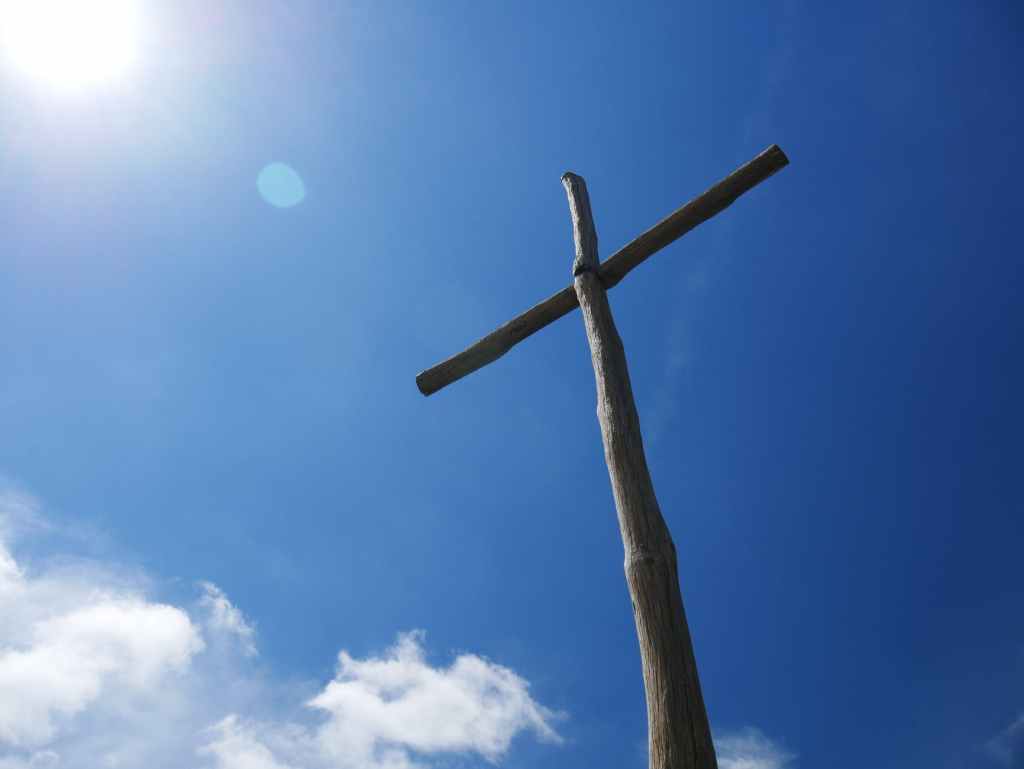
A few months ago we celebrated Christmas, the birth of Jesus. It all seems so happy and joyful, full of so much promise, then we arrived at Good Friday and everything seems to be going in the wrong direction. It’s like it wasn’t meant to end like this.
Jesus had gone about doing good, healing the sick, delivering the bound, preaching the good news of the kingdom. On Palm Sunday it seemed like everyone was on his side – hope was rising, but a few days he’s arrested, accused and tried. Pilate says he can find no fault in him and seeks a way out, but no, crucify him they cry, with a venom that says all.
So Jesus is handed over to the authorities, scourged and nailed to a cross and left to die along with two criminals. Darkness covers the land.
All this may have taken the world by surprise, but not Jesus. He knew all along what was going to happen, that he must go to Jerusalem, suffer, bleed and die. He knew that in doing so he was giving his life as an atoning sacrifice for our sin. After all, his name was called “Jesus” because he would save his people from their sins. And didn’t he also say that he would give his life as a ransom for many, that he would die and rise again.
You see to understand Good Friday, you have to remember the otherness and holiness of God and the creatureliness and sinfulness of humanity and the gulf between. In the words of the hymn writer:
“Oh, the love that drew salvation’s plan!
Oh, the grace that brought it down to man!
Oh, the mighty gulf that God did span
At Calvary!”
Or in the words of a modern song:
“How great the chasm, that lay between us…”
A gulf, a chasm, indeed. And it was huge. One that neither God nor humanity could simply resolve. It couldn’t be dealt with by a simple, “I’m sorry”, on our part, and “I forgive you”, on God’s part, now let’s get on with life. God could not simply overlook humanities rebellion – this was no small demeanour. Such a simplistic view would leave God open to the charge of unrighteousness.
As Carnegie Simpson put it, “forgiveness to man is the plainest of duties; to God it is the profoundest of problems”.
It required Jesus, the Son of God taking on human flesh, in order to be a true mediator. No man was good enough.
It required him to live in our place, to be tempted in every way as we are, it required a life lived out obediently, followed by a sacrificial atoning death – the just for the unjust, that we might be reconciled to God. Yes, a penal substitution – how we recoil at that, look for ways round it. I wish it could be so, but it had to be.
This was more than an amazing demonstration of love as some divine example. It was more than a defeating of the powers so that we can live free of them. It was a conquering of Satan, Sin, Death and Hell through a substitutionary at-one-making sacrifice, in order that we might become the righteousness of God in him! Staggering!

 The Word 4 Life